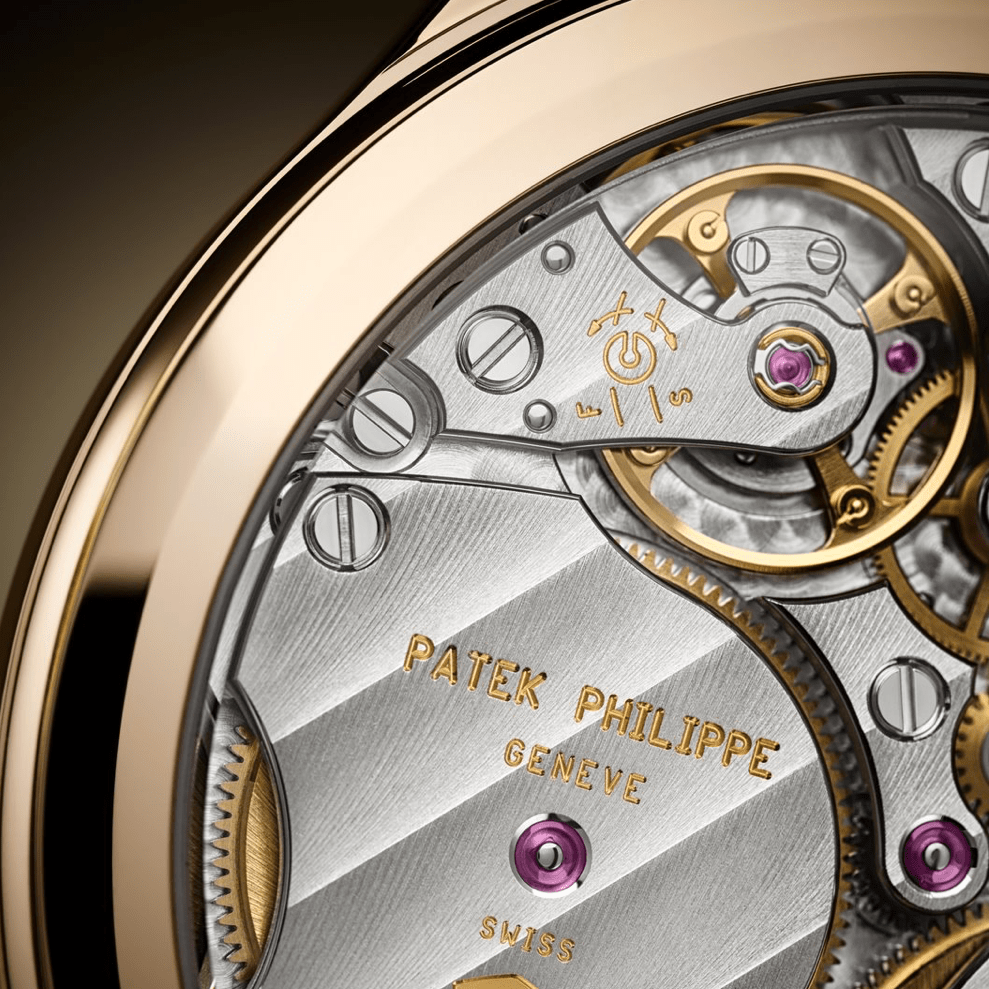
The all-new caliber 30-255 PS utilizes the latest evolution of a regulating heavyweight to achieve and maintain precision
As we accelerate further away from an analog world and progress deeper into a digital one, we trade one headache for another. The digital world has flaws; however, I am grateful society no longer has to suffer from the headache of inaccurate timekeeping. We’re surrounded by devices that sync to atomic clocks for precision, and therefore, timekeeping is no longer an issue – even setting them is done automatically in most cases. The rise of digital clocks in the late twentieth century has liberated us from our dependency on analog devices. Thus, the demand from watch manufacturers to improve in this area has dwindled.
No one is missing important moments of their life because their wristwatch has been losing five or even ten seconds a day, right? We now have the luxury to enjoy these little ticking miracles primarily for their beauty. Therefore, the societal demand for manufacturers to improve accuracy is less critical than it once was – and the monetary investment required is substantial. Nevertheless, while manufacturers strive for improvement, one remains obsessed with precision at all costs.

Since the formation of the company, Patek Philippe has made accuracy its business. At its core, the manufacturer applies real watchmaking solutions rather than gimmicks to achieve and maintain its razor-sharp preciseness. Unveiled this year, the all-new 30-255 PS manual wind caliber powering the Calatrava Ref 6119 is a tremendous example. It won’t be heralded as an engineering feat like the Caliber 89 or the Grandmaster Chime, but that doesn’t diminish the deft watchmaking beneath the dial. Although incredibly subtle, it’s an essential step in maintaining its supremacy. And it should be recognized as it represents exactly the type of company Patek Philippe has always been and still is – synonymous with precision.
My early days with the brand were like a game of “Whack-A-Mole.” Everything I learned throughout my training led me to more questions. Spending time with a watchmaker to understand why Patek Philippe watches are so accurate only uncovered more questions. I loved it. I fit each piece of info together like a puzzle. The picture became clearer with countless conversations at the workbench while peering through a microscope. I can’t unpack all of it here, but I want to touch on the cornerstone of how the manufacturer carries out its staggering rate of exactness. First, let’s wind back history to a competitive era when Patek Philippe stole the show – this was a time when mechanical accuracy really mattered.
Developing mechanical movements to achieve adequate precision for marine navigation is a fascinating tale. The story’s hero is John Harrison, a self-educated English carpenter and clockmaker who created the first portable clock sufficiently accurate to determine longitude at sea. His device kept time to within three seconds a day, making it far more precise than even the best watches of the day.
This crucial development in navigation during the 18th century paved the way for “chronometer competitions” at the Astronomical Observatories in Western Europe.
Marine Chronometers and clocks for scientific use worked only in one position, while their civilian counterparts were mobile. By establishing these Observatories, the accuracy of civilian watches – which were carried around in pockets and lying flat on bedside tables – could officially be measured. That’s because Observatory testing would account for the multiple positions of these watches and the varying temperatures they would encounter daily. With the framework and parameters for evaluation now established, the distinguished watchmaking houses jousted to prove their worth at world fairs and great exhibitions during the nineteenth century. Patek Philippe passed with flying colors.
In twenty-nine international exhibitions, Patek Philippe earned twenty Gold Medals and one Silver Medal (the other eight times, they served on the jury and did not compete). These triumphant results resonated with customers and elevated the Patek Philippe brand. Furthermore, the prizewinning movements would be cased up and sold as they were highly sought after among collectors. These competitions were so influential that they would become the greatest marketing tool in establishing a reputation of performance – and accompanying each one of these watches was their official rating certificate from the Observatory.
Even in the twenty-first century, with the great observatory competitions now in the distant past, these award-winning mechanisms still compel bidders to pay millions at auction for an individual watch. An astonishing testament to this is J.B. Champion’s Ref 2458.

In 1959, Patek Philippe ran a two-page advertisement in America with specific messaging on precision. Its main purpose was to address the astronomical accuracy of each Patek Philippe model, while also highlighting observatories – stating: “An electronic observatory-motivated time-recorder presides at the work table of every Patek Philippe watchmaker. He makes adjustments with mathematical exactitude until there is an absolute minimum of variance between the watch in his hand and the arbiter of time on earth at Greenwich, England.”
And goes on to say
“Every Patek Philippe must maintain its Observatory precision not just for a reasonable length of time, but indefinitely.”
Therefore, the challenge for Patek Philippe during these competitions – and still to this day – is two-fold: achieve a high accuracy rate and maintain it. The cornerstone on which Patek Philippe builds its precision is the mighty Gyromax® balance.
The balance assembly regulates the flow of time and is responsible for the precision of a watch. Therefore, it is the regulating organ of a mechanical movement. This ensemble includes a balance wheel and spring that oscillates to create an impulse on the escapement. Patek Philippe’s version was created, and through a series of patents in 1949 and again in 1951, the Gyromax® was officially on record. This invention is used in all modern Patek Philippe wristwatches. Its genius design allows for extreme accuracy along with convenient regulation.
Now, back to present day…
Fourth-generation President Thierry Stern enjoys designing watches while pushing the limits of watchmaking. Tirelessly working to narrow the performance gap between digital and mechanical means there is no wheel or spring exempt from being redesigned, if necessary, in that enterprise. With the strict criteria of the Patek Philippe Seal lighting the way, the team ushers in the latest evolution of the Gyromax® by unveiling the all-new 30-255 PS movement powering the Ref 6119. This heavyweight of regulation just got heavier.
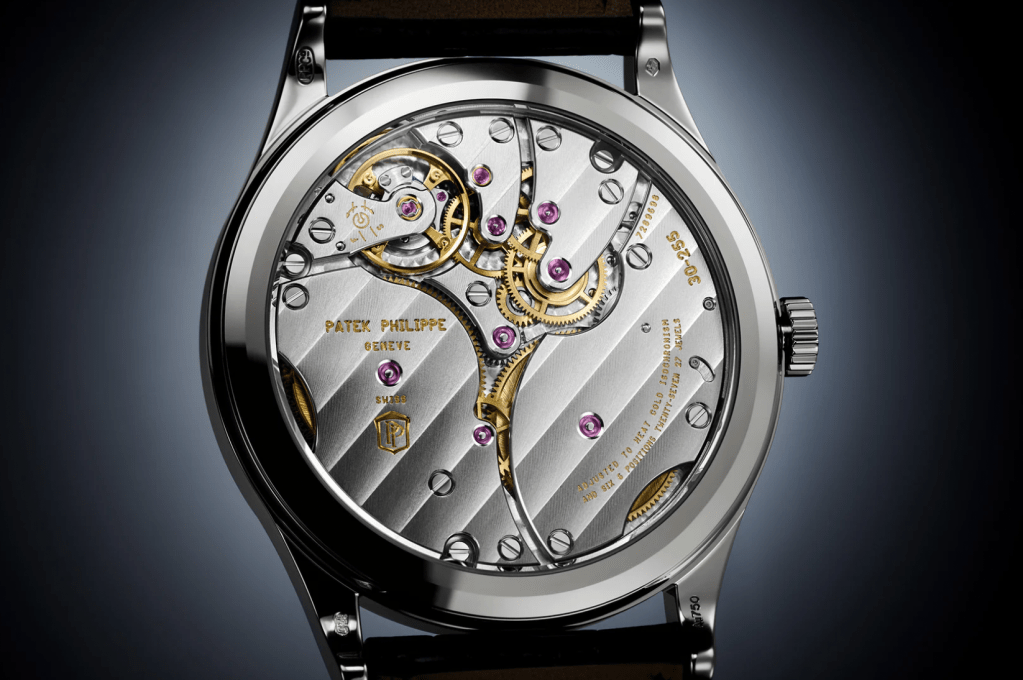
It was determined that by increasing the circumference of the balance wheel would deliver a notable improvement in rate accuracy. Customers may not notice this “notable” improvement, but it is nonetheless essential. One level of difficulty the engineers face is arranging all 164 parts of this caliber within a tight space – now made even tighter by incorporating a second mainspring barrel. It’s not just about solving for greater accuracy but also for compact comfort on the wrist. Ultimately, these brilliant minds went to extraordinary lengths to meet all objectives and again achieved gold.
Integrating this new balance wheel allows for a greater moment of inertia and offers greater stability in withstanding daily turbulence encountered by the wearer. It is an elegant solution – free of gimmicks – that remains easily accessible to watchmakers for regulation. It is also endowed with two mainspring barrels for an added jump in power supply for a minimum of 65 hours – nearly three days! Measuring in at 31mm while fulfilling the desired maximum deviation of -3/+2 seconds in 24 hours.

The result is improved rate stability and simplifies the precision adjustment of the movement. Once again, Patek Philippe harmoniously pairs aesthetics with performance. Although the Observatory no longer awards medals, every owner should feel proud to know they’re wearing a bit of this history on their wrist – and Patek Philippe remains steadfast in its investment in prizewinning levels of precision for their customers.
 The Thoughtful Collector